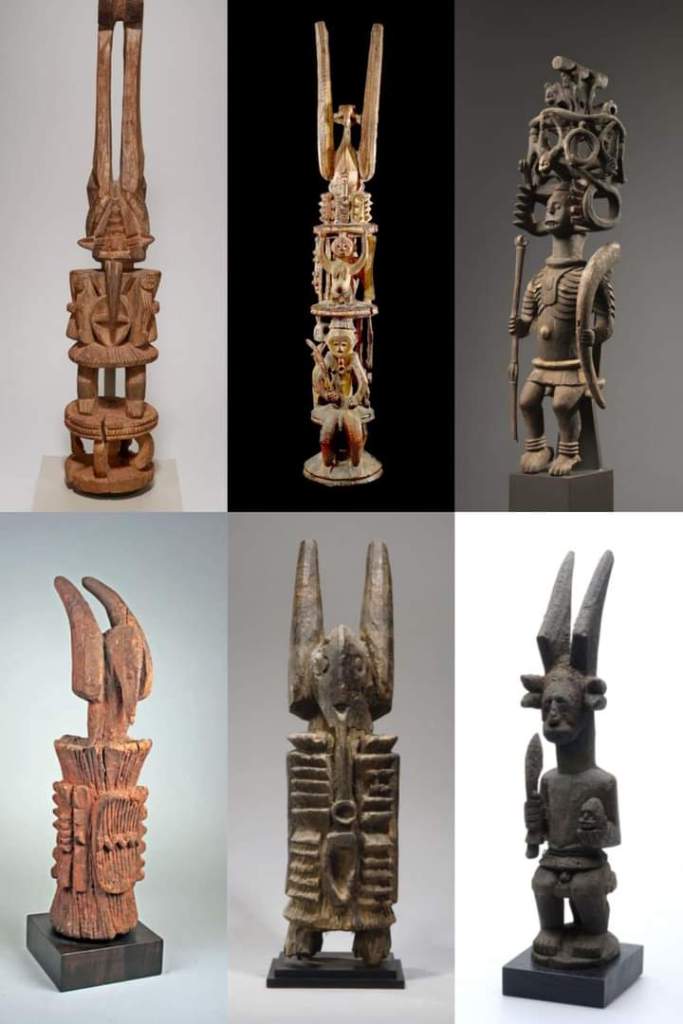

Ikenga is the Igbo symbol of strength and success. It is significant and a carving that depict success and willpower. It is a symbol associated with achievement and the awakening of the inner strength which is believed to represent a man’s personal Chi. It is made by combining two words, “Ike and Nga” (Ngagharị). The power or strength of motion or exploration. Compared to the ọfọ, the Ịkenga is another important spiritual totem and artifact of the Igbos, which has deep spiritual symbolism. It is not a deity. However, ọfọ and Ikenga are consecrated to activate their spiritual efficacy and its important cultural significance which are attached to the carvings even in their ordinary form. IKENGA means “ike nji aga”, the source, strength and courage that epitomizes one’s energetic life of being enterprising to every achievement in life. IKENGA connotes the symbol of achievement, courage, progress, time and productivity which symbolic totem is usually found through the use of one’s right hand. Some people are left-handed but in Igbo land “onye ọ bụla na-eme aka eke” is identified as a thief. Realistically, not every left-handed person is a thief, it can be a behavioral pattern, can mean that is their own “place of strength”. Before the arrival of the colonialists and advent of imported religion, every family had the ikenga, the reason most artifacts originated from Igbo land. The only and same reason one will always see the Ikenga in museums around the world. The best well carved Ikenga, could be seen displayed in museums, like the British museum, Enugu Museum among others.
After initiation into the age-grade, specially carved consecrated Ikenga were given by some families as a symbol of ushering their sons into personal achievement and success in their endeavors. It could be in professions like Carving (artist), blacksmithing, farming or hunting. It will be handed to them using the right hand (aka Ikenga). The gesture of using the right hand is believed to be the active hand for success in any work. Some distinguished women (in pottery, weaving and trading) owned it too but not much as the men, as they were the ones to prove their achievements. In ancient times, most young men had their IKENGA carved once they begin different vocational careers. The design of the IKENGA is not static. It is prone to evolving just as the responsibility of the owner changes. A young man whose main task is to defend his village receives a warrior’s IKENGA holding a sword. When the same man becomes accomplished as an elder, then he will get a title holder’s IKENGA that depicts a hand holding a sacred staff. The man’s chosen profession which is contrary will not bring him success. He has the responsibility of guiding and controlling his Ikenga either by rejecting or throwing the Ikenga (statue) away. He will choose a new Ikenga (new profession) which is better than the former. Ikenga is what makes everything function in the universe, our ancestors understood that for there to be progression in life there’s must be an active ikenga. The IKENGA has to do with hard work, career and one’s area of expertise.
In the olden days, the role of women were to become wives and mothers. Women were into trade, agriculture and beautification while men basically had careers and means to provide for the family. In those days, women were not supposed to labour outside their husband’s house or have to career, her husband is supposed to do the work and hustling to provide for the family. A woman’s husband is her masculine Energy (her Ikenga). Today, the world has evolved and women now work to provide for themselves and their family. Women have harnessed the energy our forefathers believed was meant for only men. I believe harnessing this energy, has made women independent, courageous and career oriented.
With what is happening in the world, I now know why our forefathers did not allow women have Ikenga, not because it is NSO (abomination) but because of the effect it would have on women. This energy makes women masculine in nature, they become bold, courageous, independent, strong willed and career driven. Which men see as competition or being challenged by women folk.
ATTRIBUTES OF IKENGA.
The wooden statue comes in various shapes and sizes with horns like that of a ram one. The characteristics of a ram is a good definition of how an Ikenga works in the spiritual realm. The ram’s attribute for being bold, courageous, aggressive is portrayed in the shape of an Ikenga. IKENGA represents the divine value, spirits and strength to accomplish one’s purpose and life path on earth. Most people who reincarnated have IKENGA as a symbol and gift from their incarnator. Ramming strength of the ram shows great effort, confidence and way it fights its battle. The energy of the Ikenga is masculine in nature. This is why women in some part of Igbo land are discouraged from having an Ikenga for fear they will overshadow and intimidate their husbands. Majority of women that have Ikenga are Ndị Adaeze nwanyi called to serve spirits in the ancestral way of Ọdịnanị Igbo Spirituality. In the real sense of it, a woman’s Ikenga is her husband because he is there for her, to protect her from dangers, help her in achieving the best in her life and spiritual field of endeavors. The IKENGA is vital and not to be toyed with. Igbos regard it as an important part of one’s self but do not worship it. It is a reflection of one’s self image, career choice, strength, that depicts achievement. It could be oncoming future achievement. The IKENGA energizes one to be better, then drive one to work more on their physical condition in life while striving to be greater in dignity and labor coupled with having a good pedigree which help to build solid and good reputation in the society. This representation is gotten from wood. IKENGA is carved using Ogilishi or Orji trees then activated during Chi appeasement (Chi Ritual).
There are different types of the Ikenga carvings. The most popular ones are the:
A. Ikenga Mmadụ – human figure with animal or divinity carvings on the head-could also be horns, seated on a stool, holding a machete in the aka ikenga (right hand) and in the left hand, holding head (depicting warriors victory), ọfọ, okike (elephant tusk) or oji. Each has a different significance, and ịchi traditional marks on its face.
B. Ikenga Mmụọ- represents Ndichie (ancestors); usually represented with two horns seated on cylindrical shaped carve.
C. Ikenga Ọwa Ọta or Ikenga Oge: the two faced Ikenga. This is the oldest form/shape of Ikenga in ala igbo. It signifies the old and new age. Over the decades, some communities celebrate their annual Ikenga festival. This is to acknowledge their success in every human and spiritual endeavors. Communities and villages also have IKENGA. In this instance, it known as IKEOHA/IKEDIOHA. As humans have Ikenga, mmụọ (spirit) also have Ikenga, without their ikenga they cannot function. Inasmuch as Ndị Ịgbo revere Ikenga, they believe as long as a man’s ikenga is active, he can wrestle the spirits and conquer. A man’s manhood is a physical evidence of IKENGA . Igbos believe an inactive IKENGA is useless and should be used as firewood, hence the proverb; “Ikenga adịghị ire, e were ya waa nkụ.” One could argue in the present day, Ndị Ịgbo still exude the enterprising, achievement and victorious spirit in every endeavors, even without any physical IKENGA, with the consistent notion of “Igbo na-agba mbọ” which is seen in how they rose again after the genocide that took everything from them. Igbos are resilient, industrious and down to earth.
@dibianwangwuuchendu
WhatsApp MSG only
+2347042519747
 DIBIA NWANGWU UCHENDU