INCENSE: ORIGIN, TYPES, USES.
Incense is aromatic biotic material that releases fragrant smoke when burned. The term is used for either the material or the aroma. The word incense comes from Latin incendere meaning to burn.
Incense is composed of aromatic plant materials, often combined with essential oils. The forms taken by incense differ with the underlying culture, and have changed with advances in technology and increasing number of uses.
Incense can generally be separated into two main types: “indirect-burning” and “direct-burning”.
Indirect-burning incense (or “non-combustible incense”) is not capable of burning on its own, and requires a separate heat source.
Direct-burning incense (or “combustible incense”) is lit directly by a flame and then fanned or blown out, leaving a glowing ember that smoulders and releases a smoky fragrance. Direct-burning incense is either a paste formed around a bamboo stick, or a paste that is extruded into a stick or cone shape.
Combustible bouquets were used by the ancient Egyptians, who employed incense in both pragmatic and mystical capacities. The purpose of the usage of incense stick varies; some human beings use it for the duration of meditation and rituals, even as some use it to kill insects.
Incense was burnt to counteract or obscure malodorous products of human habitation, but was widely perceived to also deter malevolent demons and appease the gods with its pleasant aroma.
Incense burners have been found in the Indus Civilization (3300–1300 BCE). Evidence suggests oils were used mainly for their aroma. This was the first usage of subterranean plant parts in incense. New herbs like Sarsaparilla seeds, frankincense, and cypress were used by Indians. Some incense, depending on the contents, may also act as organic insect repellent.
The oldest source on incense is the Vedas, specifically, the Atharva-veda and the Rigveda. Incense-burning was used both to create pleasing aromas and a medicinal tool. Its use in medicine is considered the first phase of Ayurveda, which uses incense as an approach to healing. Incense-making was thus almost exclusively done by monks. The practice of incense as a healing tool was assimilated into the religious practices of the time. As Hinduism matured and Buddhism was founded in India, incense became an integral part of Buddhism as well. Around 200 CE, a group of wandering Buddhist monks introduced incense stick making to China.
At around 2000 BCE, Ancient China began the use of incense in the religious sense, namely for worship. Incense was used by Chinese cultures from Neolithic times and became more widespread in the Xia, Shang, and Zhou dynasties. The earliest documented use of incense comes from the ancient Chinese, who employed incense composed of herbs and plant products (such as cassia, cinnamon, styrax, and sandalwood) as a component of numerous formalized ceremonial rites. Incense usage reached its peak during the Song dynasty with numerous buildings erected specifically for incense ceremonies.
Brought to Japan in the 6th century by Korean Buddhist monks, who used the mystical aromas in their purification rites, the delicate scents of Koh (high-quality Japanese incense) became a source of amusement and entertainment with nobles in the Imperial Court during the Heian Era 200 years later. During the 14th-century Ashikaga shogunate, a samurai warrior might perfume his helmet and armor with incense to achieve an aura of invincibility (as well as to make a noble gesture to whoever might take his head in battle). It wasn’t until the Muromachi period during the 15th and 16th century that incense appreciation spread to the upper and middle classes of Japanese society.
A variety of materials have been used in making incense. Historically there has been a preference for using locally available ingredients. For example, sage and cedar were used by the indigenous peoples of North America. Trading in incense materials comprised a major part of commerce along the Silk Road and other trade routes, one notably called the Incense Route.
Local knowledge and tools were extremely influential on the style, but methods were also influenced by migrations of foreigners, such as clergy and physicians.
The combustible base of a direct burning incense mixture not only binds the fragrant material together but also allows the produced incense to burn with a self-sustained ember, which propagates slowly and evenly through an entire piece of incense with such regularity that it can be used to mark time. The base is chosen such that it does not produce a perceptible smell. Commercially, two types of incense base predominate:
FUEL AND OXIDIZER MIXTURES :
Charcoal or wood powder provides the fuel for combustion while an oxidizer such as sodium nitrate or potassium nitrate sustains the burning of the incense. Fragrant materials are added to the base prior to shaping, as in the case of powdered incense materials, or after, as in the case of essential oils. The formula for charcoal-based incense is superficially similar to black powder, though it lacks the sulfur.
NATURAL PLANT-BASED BINDERS :
Gums such as Gum Arabic or Gum Tragacanth are used to bind the mixture together. Mucilaginous material, which can be derived from many botanical sources, is mixed with fragrant materials and water. The mucilage from the wet binding powder holds the fragrant material together while the cellulose in the powder combusts to form a stable ember when lit. The dry binding powder usually comprises about 10% of the dry weight in the finished incense. These include:
Makko (incense powder) made from the bark of various trees in the genus Persea (such as Persea thunbergii)
Xiangnan pi (made from the bark of trees of genus Phoebe such as Phoebe nanmu or Persea zuihoensis.
Jigit: a resin based binder used in India
Laha or Dar: bark based powders used in Nepal, Tibet, and other East Asian countries.
Typical compositions burn at a temperature between 220 and 260 °C (428–500 °F).
TYPES
Incense is available in various forms and degrees of processing. They can generally be separated into “direct-burning” and “indirect-burning” types. Preference for one form or another varies with culture, tradition, and personal taste. The two differ in their composition due to the former’s requirement for even, stable, and sustained burning.
INDIRECT-BURNING :
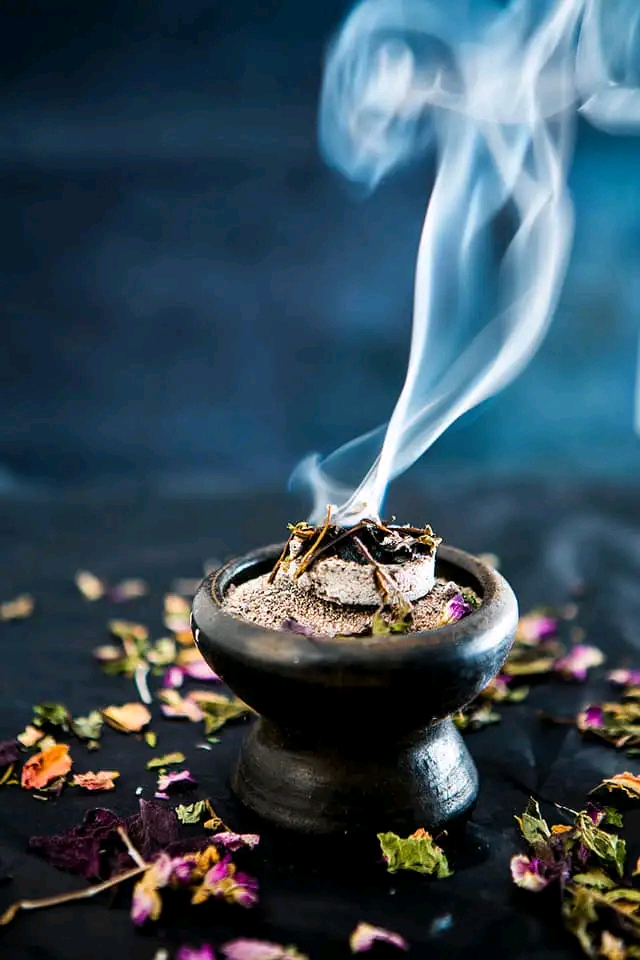
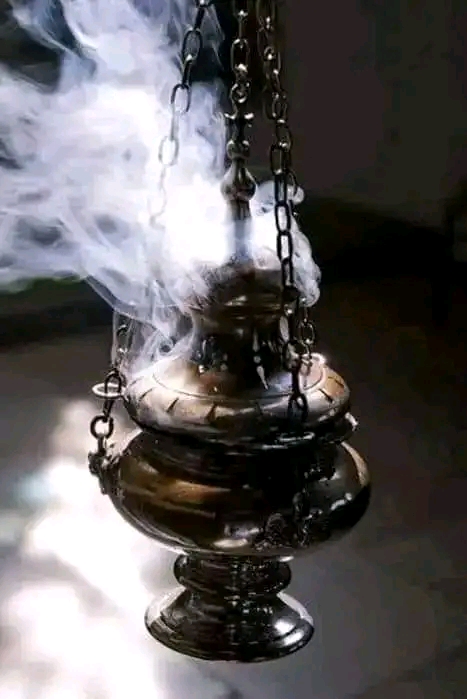
Indirect-burning incense, also called “non-combustible incense”, is an aromatic material or combination of materials, such as resins, that does not contain combustible material and so requires a separate heat source. Finer forms tend to burn more rapidly, while coarsely ground or whole chunks may be consumed very gradually, having less surface area. Heat is traditionally provided by charcoal or glowing embers. In the West, the best known incense materials of this type are the resins frankincense and myrrh. Frankincense means “pure incense”, though in common usage refers specifically to the resin of the boswellia tree.
WHOLE: The incense material is burned directly in raw form on top of coal embers.
POWDERED OR GRANULATED : Incense broken into smaller pieces burns quickly and provides brief but intense odor.
PASTE: Powdered or granulated incense material is mixed with a sticky incombustible binder, such as dried fruit, honey, or a soft resin and then formed to balls or small pastilles. These may then be allowed to mature in a controlled environment where the fragrances can commingle and unite. Much Arabian incense, also called “Bukhoor” or “Bakhoor”, is of this type, and Japan has a history of kneaded incense, called nerikō or awasekō, made using this method. Within the Eastern Orthodox Christian tradition, raw frankincense is ground into a fine powder and then mixed with various sweet-smelling essential oils.
DIRECT-BURNING
Incense coils hanging from the ceiling of an East Asian temple
Direct-burning incense, also called “combustible incense” is lit directly by a flame. The glowing ember on the incense will continue to smoulder and burn the rest of the incense without further application of external heat or flame. Direct-burning incense is either extruded, pressed into forms, or coated onto a supporting material.
This class of incense is made from a moldable substrate of fragrant finely ground (or liquid) incense materials and odourless binder. The composition must be adjusted to provide fragrance in the proper concentration and to ensure even burning. The following types are commonly encountered, though direct-burning incense can take nearly any form, whether for expedience or whimsy.
COIL: Extruded and shaped into a coil without a core, coil incense can burn for an extended period, from hours to days, and is commonly produced and used in Chinese cultures.
CONE : Incense in this form burns relatively quickly. Incense cones were invented in Japan in the 1800s.
CORED STICK: A supporting core of bamboo is coated with a thick layer of incense material that burns away with the core. Higher-quality variations have fragrant sandalwood cores. This type of incense is commonly produced in India and China. When used in Chinese folk religion, these are sometimes known as “joss sticks”.
DHOOP OR SOLID STICK : With no bamboo core, dhoop incense is easily broken for portion control. This is the most commonly produced form of incense in Japan and Tibet.
POWDER : The loose incense powder used for making indirect burning incense is sometimes burned without further processing. Powder incense is typically packed into long trails on top of wood ash using a stencil and burned in special censers or incense clocks.
PAPER : Paper infused with resin or oils extracted from fragrant material, folded accordion style, is lit and blown out. Examples include Carta d’Armenia and Papier d’Arménie.
ROPE : The incense powder is rolled into paper sheets, which are then rolled into ropes, twisted tightly, then doubled over and twisted again, yielding a two-strand rope. The larger end is the bight, and may be stood vertically, in a shallow dish of sand or pebbles. The smaller (pointed) end is lit. This type of incense is easily transported and stays fresh for extremely long periods. It has been used for centuries in Tibet and Nepal.
Moxa tablets, which are disks of powdered mugwort used in Traditional Chinese medicine for moxibustion, are not incenses; the treatment is by heat rather than fragrance.
Incense sticks may be termed joss sticks, especially in parts of East Asia, South Asia and Southeast Asia. Among ethnic Chinese and Chinese-influenced communities these are traditionally burned at temples, before the threshold of a home or business, before an image of a religious divinity or local spirit, or in shrines, large and small, found at the main entrance of every village. Here the earth god is propitiated in the hope of bringing wealth and health to the village. They can also be burned in front of a door or open window as an offering to heaven, or the devas. The word “joss” is derived from the Latin deus (god) via the Portuguese deos through the Javanese dejos, through Chinese pidgin English.
Incense-stick burning is an everyday practice in traditional Chinese religion. There are many different types of stick used for different purposes or on different festive days. Many of them are long and thin. Sticks are mostly coloured yellow, red, or more rarely, black. Thick sticks are used for special ceremonies, such as funerals.
SPIRAL INCENSE , with exceedingly long burn times, is often hung from temple ceilings. In some states, such as Taiwan, Singapore, or Malaysia, where they celebrate the Ghost Festival, large, pillar-like dragon incense sticks are sometimes used. These generate so much smoke and heat that they are only burned outside.
Chinese incense sticks for use in popular religion are generally odorless or only use the slightest trace of jasmine or rose, since it is the smoke, not the scent, which is important in conveying the prayers of the faithful to heaven. They are composed of the dried powdered bark of a non-scented species of cinnamon native to Cambodia, Cinnamomum cambodianum. Inexpensive packs of 300 are often found for sale in Chinese supermarkets. Though they contain no sandalwood, they often include the Chinese character for sandalwood on the label, as a generic term for incense.
Highly scented Chinese incense sticks are used by some Buddhists. These are often quite expensive due to the use of large amounts of sandalwood, agarwood, or floral scents used. The sandalwood used in Chinese incenses does not come from India, its native home, but rather from groves planted within Chinese territory.
INCENSE IN INDIA
Incense sticks, also known as agarbattī and joss sticks, in which an incense paste is rolled or moulded around a bamboo stick, are the main forms of incense in India. The bamboo method originated in India and is distinct from the Nepali/Tibetan and Japanese methods of stick making without bamboo cores. Though the method is also used in the west, it is strongly associated with India.
The basic ingredients are the bamboo stick, the paste (generally made of charcoal dust and joss/jiggit/gum/tabu powder – an adhesive made from the bark of litsea glutinosa and other trees) and the perfume ingredients – which would be a masala (spice mix) powder of ground ingredients into which the stick would be rolled, or a perfume liquid sometimes consisting of synthetic ingredients into which the stick would be dipped. Perfume is sometimes sprayed on the coated sticks. Stick machines are sometimes used, which coat the stick with paste and perfume, though the bulk of production is done by hand rolling at home. There are about 5,000 incense companies in India that take raw unperfumed sticks hand-rolled by approximately 200,000 women working part-time at home, and then apply their own brand of perfume, and package the sticks for sale. An experienced home-worker can produce 4,000 raw sticks a day. There are about 50 large companies that together account for up to 30% of the market, and around 500 of the companies, including a significant number of the main ones, including Moksh Agarbatti and Cycle Pure, are based in Mysore.
TIBETAN INCENSE
refers to a common style of incense found in Tibet, Nepal, and Bhutan. These incenses have a characteristic “earthy” scent to them. Ingredients vary from cinnamon, clove, and juniper, to kusum flower, ashvagandha, and sahi jeera.
Many Tibetan incenses are thought to have medicinal properties. Their recipes come from ancient Vedic texts that are based on even older Ayurvedic medical texts. The recipes have remained unchanged for centuries.
JAPANESE INCENSE
In Japan incense appreciation folklore includes art, culture, history, and ceremony. Incense burning may occasionally take place within the tea ceremony, just like calligraphy, ikebana, and scroll arrangement. Kōdō the art of incense appreciation, is generally practiced as a separate art form from the tea ceremony, and usually within a tea room of traditional Zen design.
Agarwood and sandalwood are the two most important ingredients in Japanese incense. The characters in agarwood mean “incense that sinks in water” due to the weight of the resin in the wood. Sandalwood is used in the Japanese tea ceremony. The most valued sandalwood comes from Mysore in the state of Karnataka in India.
IGBO INCENSE
Here, it is made majorly from indigenous plants like Newbouldia (Ogirisi) , Basil leaves (Nchuanwu) , Onions, Moringa,Dried Ginger,Dried Garlic, Nutmeg, Inyi bark, dried cayenne Pepper, dried orange peels, dried plantain leaves, dried lemon grass leaves. The combination of two or more leaves and barks, make up any indigenous incense. They are collected, dried, crushed, grinded and preserved, then used as incense. Most times, some spiritualists prefer using the foreign imported incense sticks from China, Japan, Indian etc for their spiritual works. They come with all sorts of names and spiritual purposes.
@dibianwangwuuchendu WhatsApp MSG only
+2347042519747
 DIBIA NWANGWU UCHENDU