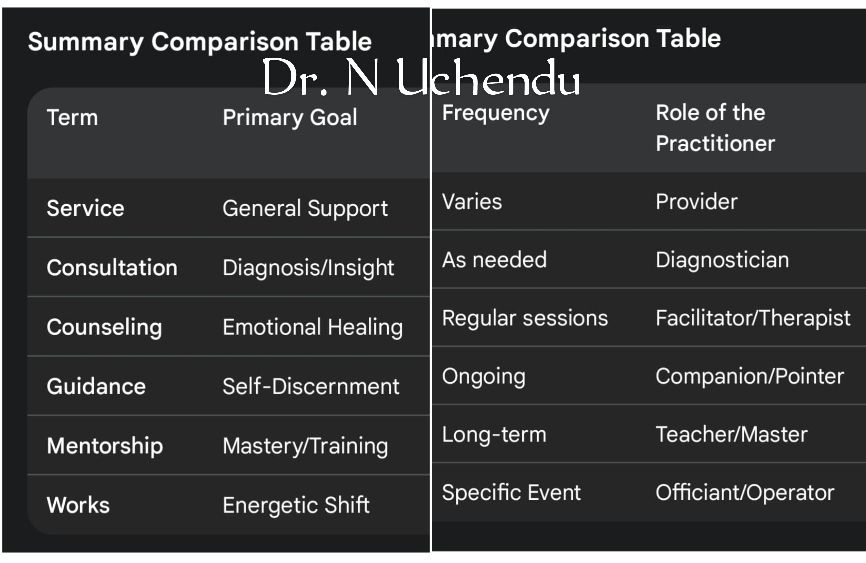
Navigating the world of spirituality involves terms that seem similar but serve very different purposes. Understanding these distinctions helps you identify exactly what kind of support you need at any given time.
Here is a breakdown of the differences between these six core spiritual practices.
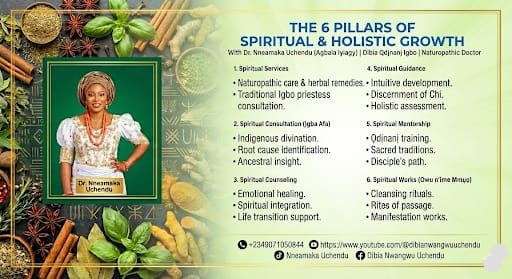
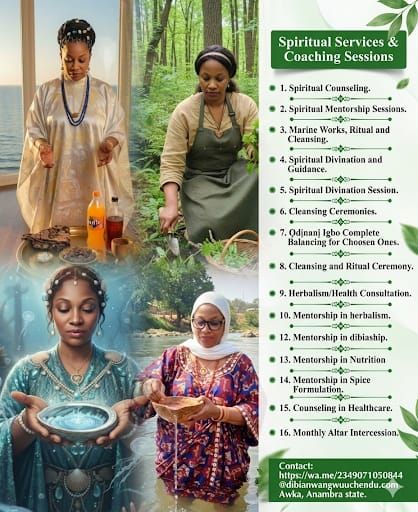
1. Spiritual Services.
Definition: A broad, umbrella term for any professional or communal offering designed to support a person’s spiritual life.
* Explanation: This is the “industry” or “category” level. It includes everything from organized religious ceremonies to private holistic sessions. It is the “what” being offered to the public.
* Example: A holistic center listing “Reiki healing, Tarot reading, and House blessings” on their website is offering a menu of spiritual services.
2. Spiritual Consultation.
Definition: A diagnostic or exploratory session used to identify a specific problem, spiritual root cause or path forward.
* Explanation: Think of this as the “doctor’s appointment” of the spiritual world. It is usually a one-time or occasional meeting where the practitioner uses tools (like divination, astrology or psychic insight) to assess your current energy or situation.
* Example: Visiting a Dibia or a psychic because you feel “blocked” in your career. The practitioner performs a reading to tell you why the block exists.
3. Spiritual Counseling.
Definition: A therapeutic approach that integrates a person’s spiritual beliefs into the process of emotional and mental healing.
* Explanation: Unlike traditional psychology, which may focus solely on the mind, spiritual counseling addresses the soul’s role in trauma, grief or life transitions. It is collaborative and often involves talking through deep-seated beliefs.
* Example: Someone meeting with a counselor to discuss how their loss of faith is contributing to their depression, working to find meaning through their spiritual lens.
4. Spiritual Guidance.
Definition: Support provided by a seasoned practitioner to help an individual discern their own spiritual path or “inner voice.”
* Explanation: The guide does not tell you what to do. Instead, they provide tools (like meditation or prayer techniques) to help you hear your own intuition or the “Divine.” It is about self-discovery.
* Example: A person meeting with a spiritual director once a month to discuss their prayer life and how they can better recognize the signs the universe is sending them.
5. Spiritual Mentorship.
Definition: A long-term, committed relationship where an experienced teacher (Mentor) trains a student (Mentee) in a specific tradition or practice.
* Explanation: This is more intensive than guidance. It involves “apprenticeship.” The mentor shares their specific wisdom, “secrets” of the craft and holds the student accountable for their growth and discipline.
* Example: A student learning the specific herbs, chants and laws of Igbo Ọdịnanị under the tutelage of an elder priest over several years.
6. Spiritual Works
Definition: The active, ritualistic application of spiritual laws to produce a change in the physical or energetic world.
* Explanation: If consultation is the “diagnosis,” spiritual works are the “surgery” or “medicine.” These are actions taken to shift energy.
* Cleansing: Removing negative energy (e.g., a salt bath or smudging a home).
* Rites: Formal ceremonies marking a transition (e.g. a naming ceremony or initiation).
* Rituals: Scripted actions performed for a specific intent (e.g., lighting specific candles to attract abundance).
* Example: After a consultation reveals a “spiritual weight,” the practitioner performs a cleansing ritual at a river to wash away that weight.
@dibianwangwuuchendu
WhatsApp MSG only.
+2349071050844.
+2347042519747.

 DIBIA NWANGWU UCHENDU