Culled from the book “Who Are The Öka People?”, a free e-book available on demand at eanizoba@gmail.com.
The Öka-Igbo is used and the orthography is the NSO (New Standard Igbo Orthography).
“Dibie” was what Europeans called “native doctor” or “medicine man”. Avba is divination. There are three kinds of Dibie in Öka, namely:
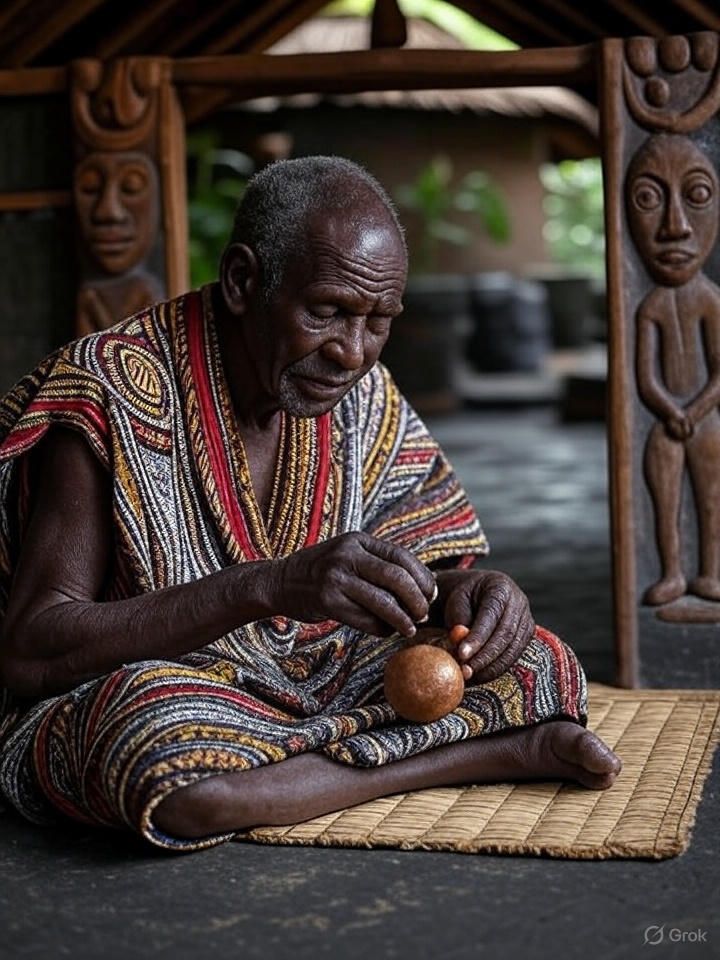
1. DibieAvba – These are the Dibie-diviners who ascertain the wishes of the Gods. They use different means to do this: some work with sand – making marks on a small heap of sand, and finding answers to questions from the marks; some work with peculiar seeds or mirrors – they are called “osen’abö” or “asaan’abö” – they stare at these peculiar seeds or into their mirrors and reveal the wish of the Gods; others use “ükpükpa” – the shells of Ögbönö seeds – which are strung together on a thin rope, and flung on the ground: the Gods speak through the manner in which the ükpükpa shells fall, some falling face up and some falling face down.
2. Dibie Aja is a specialist in performing rituals or sacrifices as requested by the Gods and revealed by the DibieAvba.
3. DibieÖgwü gives medicines to cure illnesses (herbalist) or knows the art of preparing talismans (magus).
A Dibie of any kind serves apprenticeship for seven years or more.
An Öka adage says: Ö dünanjö, a chövbaDibie! i.e, we seek the Dibie when the situation is desperate. Generally, the DibieAvba identifies the problem and indicates the appropriate sacrifice to be effected by the Dibie Aja or the appropriate ögwü to be prepared by the DibieÖgwü. So, the important elements in Ödünana are: the Dibie, our Chi or personal God, the Alüshï or functional Deities, Chineke whose portions are the Chi and Alüshï, and Chikwu or the all-containing Godhead (Nature, the infinite Space we live in).
Some people have asserted that avba (divination) is just common sense or plain hocus-pocus. But avba is neither! Let me explain the avba philosophy a bit.
Divination involves five elements: the diviner, the instrument of the oracle, the oracle, the client, and the unknown (God or Spirit). If the diviner is the client, then we have four elements.
Please note that the oracle is different from its instrument. To better understand let us consider divination with the four-lobed kolanut or Tarot cards. When thrown, the spread of the lobes of a four-lobed kolanut gives an oracle, while the four-lobed kolanut itself is the instrument for obtaining an oracle – any spread of the lobes. Again, the Tarot pack is the instrument for the expression of Tarot oracles, while a given spread of those cards provides an oracle for interpretation. So, an oracle is any disposition of the avba instrument (cowries, four-lobed kolanut, ükpükpa, special seeds, Tarot cards, etc.) through which the Chi expresses its will. Changes in the will of the Chi are followed by changes in the disposition of the oracle when reconstituted and recast. We obtain a new spread when the four lobes of the kolanut are assembled and thrown again or when the Tarot cards are re-shuffled and a new set of cards are drawn from the complete pack.
The oracle provides codes through which the invisible communicates with the diviner and his client. The meaning of each code is fixed and the diviner must master these codes and their meanings. Divination boils down to interpreting the codes provided by the oracle and adapting them to the question at hand. Thus, the diviner is required to have a cultivated imagination and intuition, in order to capture the subtle movements of the Spirit through the codes.
The role of DibieAvba in Ödünana is primordial. People complain that majority of them are liars and cheats. Maybe! But one sage told me: Dibie nine na-ashï ashï, mana ï vbü Dibie nya shïal ghï ashï maka na üvbödü ashï na-avbü eziokwu. The Dibie are liars, but when you come across a Dibie tell him to lie for you, because some lies turn out to be true. The Dibie is a trained seer, just like a trained Tarot card reader. The Tarot cards have fixed meanings. The position of each card in a spread also has a fixed meaning. The only variable element is the sequence in which the consultant picks the cards from the Tarot pack. Assume we are using only the twenty-two major trumps to interrogate the invisible. I shuffle the twenty-two cards and place them facing down on a table. I then ask you to pick four cards, one at a time, and give them to me without looking at the image on the card. I place the cards on another table in the form of a cross, the cross spread. The second card faces the first across the short arm of the cross, while the third and fourth cards are placed opposite each other at the top and foot, respectively, of the long arm of the cross. A fifth card, which is a summary of the four cards, is placed in the center of the cross.
When you went to pick the cards, “something” moved your hand to blindly pick a card among twenty-two cards. The same “something” moved your hand when you blindly picked the three other cards. But the “something” that was blindly moving your hand is simply your Chi or God within your body. Your Chi knows the answers to your queries. It uses the cards that you choose and the sequence in which you choose them to answer the relevant query. The Tarot reader simply reads out what your Chi is showing through the cards. The same is true of the DibieAvba.
An avba session usually starts with generalities concerning the client and his/her family. A good DibieAvba is able to use his oracle to identify good news or problems in the family/office without any lead from the client. Remember that the DibieAvba does not have all the answers. We listen to the Dibie without surrendering our reason. Ask questions, if you don’t understand what the Dibie is saying. Onye ajüjü anara evbu uzo. He who asks questions never misses his way. The implementation of his recommendations must be dependent on our sole judgment. That’s why my folks say: a gbachaa avba, a chïköö uche. Deliberation must follow the avba session. A minimum of three different Dibieavba should be consulted for important issues. A comparison of the three oracles would give a good indication of what to do. Remember: in avba, it is your Chi talking to you via an oracle that the Dibieavba interprets for you.
Does it mean we can’t dialogue directly with our Chi? We can, but we indulge in so much mental chatter that we cannot hear or feel the promptings of our own Chi. Hence the need for the Dibie and his oracle as the mouthpiece of our Chi. The object of yoga/meditation is to eliminate this mental noise, with a view to hearing or feeling the prompts of the Chi that resides in our own body. When you master your mind, then your Chi or Spirit will talk to you “face-to-face”. But before we acquire that mastery, the Dibie and his oracle are there to help us out. Knowledge is power and to be forewarned is to be forearmed, says the sage. So, consult the Dibieavba whenever important issues are at stake. Forget about your jeering, untutored relatives and friends. Remember that true salvation is a solo thing and in your own hands. The Öka say: Anü kal obu, na-ebu n’ödö ajü! Only stout-hearted animals live in the open ajü grassland! Because the world we live in is indeed a vast Ödö Ajü! Avba is common to the Igbo, though its practice is as varied as the Igbo language – Igbo na-asü n’onu n’onu!
Cheers!
Blogged with Nevbechi Nwoye Emma Anazövba permission.
WhatsApp MSG only


+2349071050844
 DIBIA NWANGWU UCHENDU