The concept of Ogbanje within Igbo cosmology occupies a profound, complex and often misunderstood space between spiritual philosophy, ancestral memory and human tragedy. To understand the phenomenon deeply, one must move past modern romanticized interpretations and examine the traditional linguistic, metaphysical and cultural frameworks that define it.
The Etymology and Metaphysics of the Ogbanje.
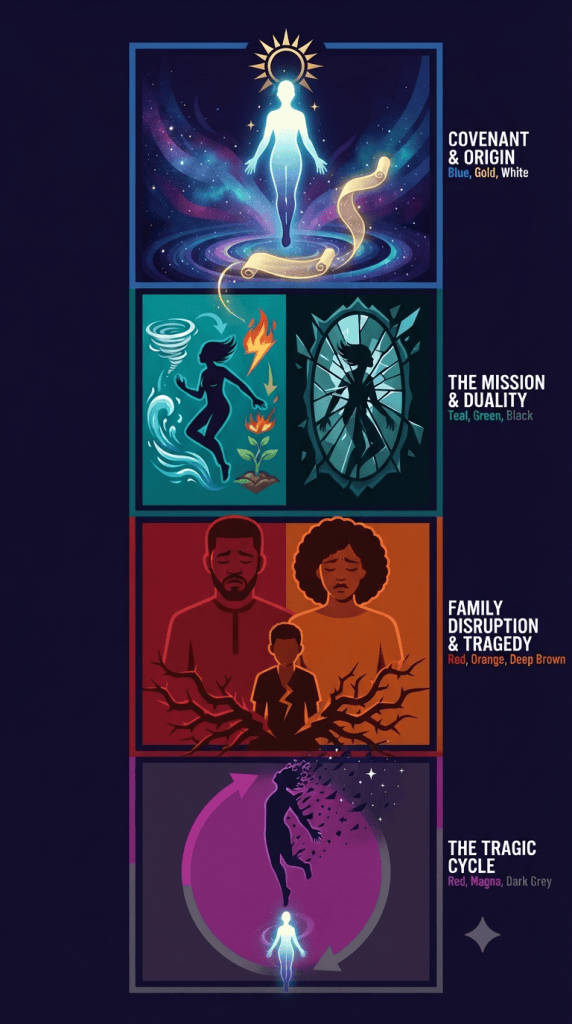
In Igbo language, words are containers of deep philosophical truth. The term Ogbanje is a compound of two root words: Ogba, which translates to an oath of allegiance, a sacred vow, a pledge or a binding agreement and Nje which means an errand, a mission, an assignment or a task. Therefore, an Ogbanje is literally defined as someone bound by a sacred covenant who was sent into the physical realm on a specific spiritual assignment.
According to traditional Igbo metaphysics, these entities or souls originated from higher dimensions or elemental forces such as water (mmili), earth (ana), air or wind (ikuku), fire (oku) or ancestral domains and descended to fulfill a designated purpose for the balance of the ecosystem and human society.
However, the tragedy of the Ogbanje lies in amnesia and breach of contract. Upon entering the physical realm, the individual suffers a total memory loss of their origin, their home and their divine mandate. Cut off from their spiritual coordinates, they begin to malfunction and drift through life without fulfilling their true purpose.
Traditional Sayings and Proverbs on the Ogbanje in Igbo Cosmology.
Igbo oral tradition use proverbs and descriptive names to categorize these wandering souls and contrast them with those who successfully honor their celestial origins:
A. “Aka n’abo, obi n’abo”: In the sacred divinatory system of Afa, this phrase describes the duplicity or internal division of the Ogbanje who straddles two worlds without fully committing to either.
B. “Ije di na ukwu, ndi na-agbaje oso”: This refers to the cyclical, transient nature of their existence while constantly fleeing back to the spirit world before completing their earthly tenure.
C. “Atulukpa obi”: A reference to a restless, wandering heart that finds no permanent settlement or peace within the human experience.
D. “Ndi ọgba ọsọ”: Those whose lives are characterized by running away or cutting their earthly journey short.
The Consequence of Broken Oaths.
When an entity fails to execute its divine mission within the allotted time frame, it becomes spiritually stranded. In traditional thought, those who successfully execute their cosmic tasks ascend and transcend, becoming respected spiritual forces, co-creators, or revered elders of the cosmological order, sometimes referred to in esoteric circles as Ugobenaja Uzoigwe.
Obviously, the ones who break their oath, rebel against the timing or attempt to use their innate powers to build personal empires outside of universal law become spiritual outlaws. Because they lack memory of their home, they wander the matrix of physical existence and manifest as disruptive forces. Traditional wisdom maintains that an Ogbanje is fundamentally distinct from an ancestral reincarnation.
While a true ancestral return connects a child directly to the lineage acknowledged through descriptive lineage names such as Nwadiana, Nwa ndi ichie, Nwa okpu, Nwada ndi gbo, Nweke, Nwoye, Nwafo or Nwankwọ. An Ogbanje is viewed as an interloper or a stranger who bypasses the natural genetic and spiritual queue of the family tree. They may displace rightful ancestral reincarnations thus bring deep sorrow to households.
Manifestations and Behavioral Patterns.
Traditional lore attributes various physical and psychological trials to the presence of an ungrounded Ogbanje within a family structure:
1. Generational and Familial Disruption: Traditional narratives often describe extreme friction where the arrival of such a child coincides with sudden tragedies, such as the mysterious death of a parent or severe financial ruin. While some variants of the mythos suggest an Ogbanje might shower a household with sudden, fleeting wealth to ensure they are pampered, others bring profound bankruptcy, debt and generational stagnation.
2. Health and Developmental Crises: Chronic afflictions such as severe childhood seizures, epilepsy, sickle cell anemia, neurological disorders, autism or profound cognitive impairments were historically viewed by traditional diagnosticians not merely as biological ailments but sometimes as outward manifestations of a violent spiritual tug-of-war or an entity refusing to anchor itself properly to the physical plane.
3. The Tragedy of Premature Death: The defining hallmark of the Ogbanje experience in folklore is the brevity of life. They typically do not attain old age. Instead, their lives are marked by a sudden, mysterious and devastating departure. This occurs precisely at the peak of their youth or the height of their potential at the very epoch when family and community expect them to bear fruit and anchor their achievements, the tragic news of their passing arrives.
Reclaiming Identity and True Alignment.
Traditionally, true spiritual stability comes from knowing one’s root. Just as an Eze Mmụọ or an Ezeana operates with absolute clarity regarding the specific deity or elemental force they serve and to which they will ultimately return, human beings require clear ancestral grounding. Those who look past superficial romanticizations of the Ogbanje recognize that true spiritual maturity involves waking up from spiritual amnesia, honoring one’s covenant with integrity and walking the path of purposeful creation rather than cyclical wandering and unresolved pain.
@dibianwangwuuchendu
WhatsApp Msgs only.
+2349071050844.
 DIBIA NWANGWU UCHENDU